Reflections on the Dragon Fight Capital
Friends of Reading Museum recently invited me to write about an object in Reading Museum that I find particularly inspiring. Here is that text which reflects upon the Dragon Fight capital (REDMG:1977.100.1). It was originally published in their newsletter in an edited version. Here is the full text.
-
Being invited to reflect on an object in the museum’s collection has led to some interesting discoveries and connections that I hadn’t considered before. As I scrolled through the selection of objects available for adoption I experienced varying degrees of interest but kept returning to the Dragon Fight capital, a modest stone carving originally from the cloisters of Reading Abbey. My choice was instinctive so I asked myself what was it about this object that caught my attention? Initially I thought it reminded me in a general sense of the sort of stone elements I’ve seen on my travels, but once I learnt what appeared to be purely abstract carvings depicted dragons interwoven with youths sticking out their tongues I knew I was closer to home territory. I am a visual artist with an enduring interest in the long history of abstraction and representation of the figure, and how form can embody meaning.
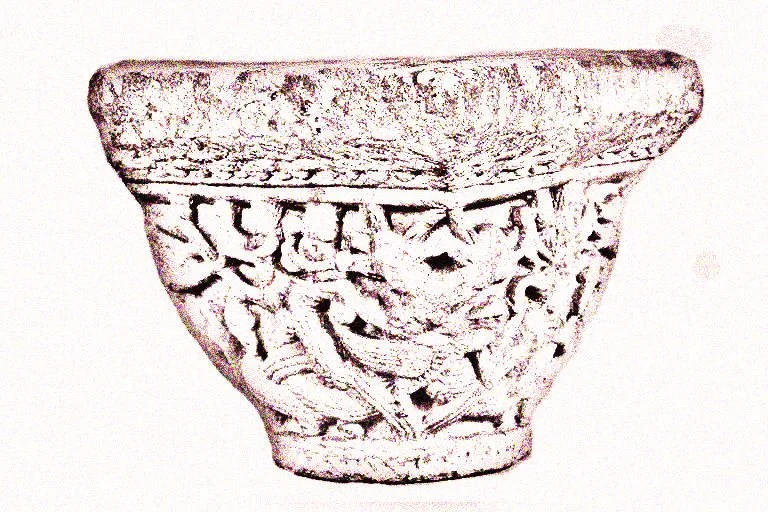
Artist’s rendition of the Dragon Fight capital
Reading Museum
Object ref (REDMG:1977.100.1)
Capital, from the Latin caput meaning 'head' is the topmost element of a column. Examples can be found in architecture around the world and have existed with all sorts of ornamentation since pre-classical antiquity. I was in the British Museum recently where capitals from Egypt in the second millennium BCE make clear that the ornamental feature was already well established long before its popular association with Ancient Greece and Rome. The Dragon Fight capital is 12th century Romanesque therefore relatively recent. I found that my reflections on the character of this object, bearing in mind the long history of its form and purpose, was a rewarding dance between the specific and generic.
The Dragon Fight capital was originally part of the cloister arcade of Reading Abbey, founded by King Henry I in 1121. The material is Caen stone, a light, creamy-yellow Jurassic limestone quarried in France and Its composition means it was ideal for carving. Caen stone features in many Gallo-Roman and Norman buildings such as Reading Abbey, Canterbury Cathedral and the Tower of London. The title refers to the carvings of winged dragons and young men sticking out their tongues. Reading Museum suggests these carvings might represent the victory of Christianity over sin, a Norse saga, or just be decorative. I’m no expert in the field but doubt such depictions could be pure decoration. I do appreciate architectural decoration but over the years I’ve encountered many lively figural incidents in churches, cathedrals and temples around the world and they always seem to provide some lively counterpoint to the religious context of which they are part. Even the abstract ornamentation of Moorish art which can be discussed in decorative terms is more than that. Its complex interlaced patterns celebrate God and uphold the spiritual and psychological values of Islam by avoiding figural representation.
My choice then was an act of recognition informed by both instinct and experience. Compared to some capitals I’ve seen elsewhere the museum object is quite modest in size and details have eroded for the same reason Caen stone was so favoured for carving: limestone is soft compared to granite. Nevertheless I find delight in it for what it tells us about our history and how important it is to realise meaning is never singular or fixed.
Someone walking through the cloisters in the 13th century would have passed numerous carved capitals and appreciated the incidents and conjunctions depicted. A capital’s physical presence not only provided architectural support, it upheld the prevailing religious order through embellishments. So what to make of the theory the carving depict a Norse saga and why does it appear in a Christian building? I looked into this briefly and the Völsung Cycle includes the story of Sigurd slaying the dragon-worm Fáfnir. It is possible the artisans who carved capitals for Christian buildings were Scandinavian and given similar creative latitude afforded to carvers of gargoyles and misericords.
This monastic world, populated with angels, martyrs and demons, crumbled when Henry VIII started to see Catholicism as limiting his power. A widespread iconoclasm arrived. Across England images, sculptures and ornamentation were recklessly destroyed. The dissolution of Reading Abbey in 1539 included the brutal execution of Reading’s last Abbot Hugh Faringdon, It may seem absurd that inert stone could be considered complicit yet the Dragon Fight capital and many other such stones from the abbey were taken to the Borough Marsh, close by the River Thames near Wargrave, Berkshire. The stones then remained submerged until the early 20th century when they were transferred to nearby Holme Park where the archaeologist Charles Keyser discovered them, leading to their accession to the museum.
This capital’s story is fascinating yet my personal interest is what it says about the power of art. If we consider the fundamentals the capital is a lump of shaped limestone from France carved by someone in the 12th century on either theological or mythic terms that we cannot today identify with confidence. I don’t think this ambiguity diminishes the life and visual wit of the imagery. In contrast the fate of this capital and the fourteen others that Keyser discovered is a solemn reminder of how art in all its forms can be turned from something that enriches life into something ‘other’, something dangerous that needs to be destroyed. By extension we can reflect on the ‘othering’ of people that driven by faith and culture is a solemn fault-line that runs through world history to the present day.
The Dragon Fight capital is not a major artwork yet it nevertheless has power. It speaks to us, to our imagination and our humanity. The youths, somewhat worn out and ambiguous, can still be seen sticking out their tongues as the dragons circle around them. We are no longer in 12th century England and in our globally connected times the meanings we assign to it now are unstable. The age and background of the spectator are major factors on interpretation and somewhere between original intent and the spectator’s understanding there is an experience. In this I believe something mysterious but human connects us to its maker and allows us to feel, for a while at least, connected.