
New York Trip I: Whitney Museum of American Art
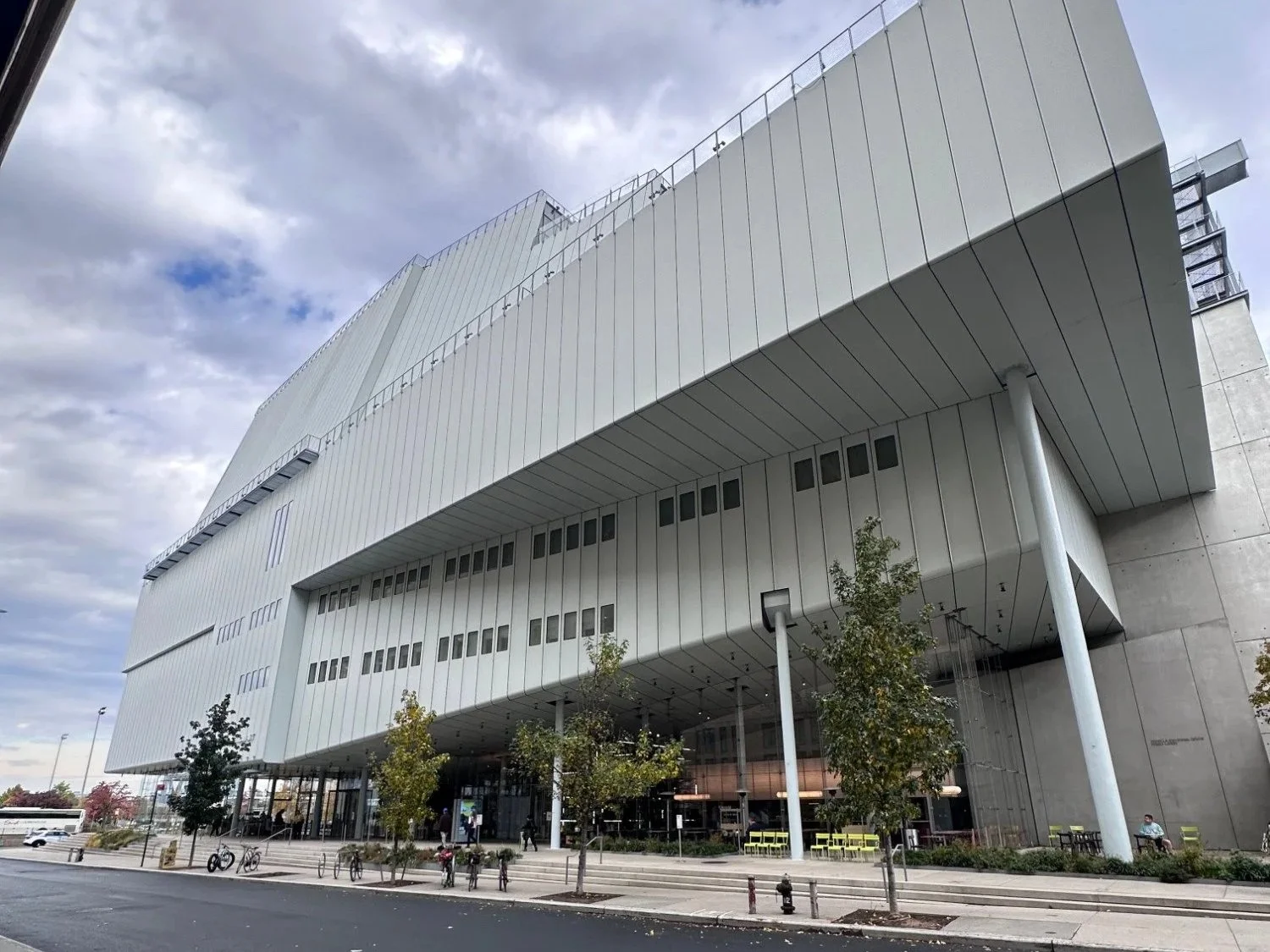
I first visited New York in 1985 and remember exploring the Whitney which since 1966 had been located in the Marcel Breuer building on Madison Avenue. In 2015 the museum reopened in a building designed by Renzo Piano that overlooks the Hudson River and the very swanky Meatpacking District.
I learnt recently the old building has become Sotheby’s. Apparently a lot of people feel unhappy about this due to how the space, which had served the museum’s focus upon curation so well, has been turned into a market-driven commercial space. I get that, and have little interest in following the latest salesroom news, but I suppose it could have been repurposed in far worse ways. Meanwhile the Whitney now has much more space for its programmes.
From the street I had thought the ‘new’ building looked rather ugly, but once inside I found it was very good, mainly because the architecture didn’t detract from the art. There are five floors of galleries (the building has eight in total) and three of those floors also have outdoor galleries which made moving around feel light and connected.
Four exhibitions stood out for me: High Wire: Calder’s Circus at 100; Sixties Surreal; “Untitled” (America) and Shifting Landscapes. For now I am only going to discuss the first three as they reflect values I consider important: a sense of play, an engagement with the surreal, and the need to work diligently.
The Calder exhibition was witty and delightful. His wire sculptures and small circus models are well known and much-loved by many yet others claim they are not serious art. Do they mean, I wonder, that great art must be serious? To talk about art critically there are many aspects to consider - one may readily think of meaning, form, materials and expression as fundamental - however one should also go further to evaulate integrity and intent. This is where technical skill finds its anchor or is found wanting. It doesn’t matter whether an artist focuses on serious themes or seeks to entertain or give pleasure, what matters is the authenticity of that expression. Identifying this is tricky and demands research, but even then the conclusion one reaches is subjective. Gut instinct and trust are very important considerations.
I walked around the exhibition a number of times and watched people’s expressions change in front of the exhibits. People connected. People smiled. That really was quite beautiful to witness. Was I standing in front of great art? I am not sure. What I do know is I find Calder’s sense of play transmits a convincing vitality and warmth; a celebration of those aspects of being human that can enrich our lives.
Sixties Surreal considers the influence of Surrealism that emerged in 1920s Paris on the art being made in 1960s America. The poet John Ashbery is quoted: "‘We all ‘grew up surreal’ without being aware of it”. This certainly rings true if one considers popular culture today. The incongruous, disturbing and prurient can be found everywhere. The exhibition reflects Ashbery’s claim so doesn’t suggest any kind of movement. The show reflects a surreal sensibility permeating the art of the sixties. The impact of Surrealism, compared to other early modernist movements like Cubism or Vorticism (which represented important shifts in consciousness but remained tethered to the art forms from which they emerged) was viral. The exhibition had many fascinating artworks. I’ve chosen Screamin Jay Hawkins by Karl Wirsum, he of the Chicago exhibition group Hairy Who, which pulls in a lot of disparate references in order to express something of Hawkin’s wild live performances.
Floor 7 of the Whitney was given over to “Untitled” (America), a survey of American art from 1900 to the 1980s. There were many significant works to mention however I’ll focus on Arshile Gorky’s The Artist and his Mother since the painting has personal significance. My MFA studies took place at Reading University 1984-86. The course was led by artist Adrian Heath and he would hold a weekly group discussion about one or other aspect of our practice, supported by historical examples. These talks were always helpful and thought-provoking, especially the one which discussed the careers of Gorky and Gottlieb. The painting reminded me of Adrian talking at some length about the trials and tribulations of Gorky’s personal life, and how he at first struggled to rise above his influences, especially Cezanne and Picasso, and find his own artist voice. The portrait with his mother only hints at the surreal, abstract paintings that he went on to make in the 1940s. He and his mother emigrated the the United States to escape the Armenian Genocide. He ended up making a great contribution to American painting in the 20th century but his life was hardly charmed. Following a fire that destroyed a lot of his work, he had to cope with cancer, a serious car accident and and a failed marriage. He took his own life in 1948.
Bearing in mind Gorky worked on this seminal painting for ten years it is surprisingly fresh. It is also much better in real life than reproduction - isn’t all good painting - although this is something that seems reversed in our age of ‘instagrammable’ art. As I remember it Heath was careful not to suggest Gorky’s considerable misfortunes influenced the trajectory of his art; the struggle Heath wished to focus upon was one of artist voice. Although I only made the following connection recently I think the point Heath wished to drive home to our group is akin to the Helsinki Bus Problem. The key point of this theory considers how all the bus routes from Helsinki start off in the same direction and visit the same bus stops but eventually diverge. The message to the individual seeking self-realisation is “stay on the bus”. To unpack this metaphor it means if one sets out in a particular destination stick with it - if you change your mind and get off the bus too early you’ll only find another bus heading in a similar direction. Worst of all keep switching and you might never leave town. Gorky described the years of his early output, which was heavily influenced by making copying Cezanne, Picasso, Miró and Leger, as ‘apprenticeships’.
There is an excellent piece by James Clear here which discusses the Helsinki Bus Theory in more detail. I like the point he makes about the importance of re-work over simply working. Through patient re-workings and a serious commitment to an activity one may gain understanding that leads on to mastery. Gorky’s apprenticeships and the mature period that followed reflect this journey, and this was something I know Heath wanted me and my peers to heed.
Alexander Calder, The Brass Family
Karl Wirsum, Screamin J Hawkins
Arshile Gorky, The Artist and his Mother
Note: clicking on the image detail will launch the full image.
